Brazilian Jiu-Jitsu (BJJ): The Complete Beginner’s Guide
We’ve all seen it in movies: the hero is cornered, facing a much larger opponent. A frantic exchange of punches follows. But in the real world, studies and law enforcement data consistently show most physical altercations end up in a messy, chaotic clinch and often go to the ground. What do you do then?
Brazilian Jiu-Jitsu (BJJ) is a martial art built to answer that one specific question. It’s a self-defense system that assumes you’re in a worst-case scenario—on the ground with someone bigger and stronger—and gives you a clear path to safety and control. Where striking becomes difficult and ineffective, a new set of rules applies.
This is why BJJ is often called “human chess.” The entire system was designed for a smaller person to overcome a larger adversary using leverage and technique, not raw power. It teaches you how to use your body’s mechanics to control an opponent’s limbs and position, turning their size and strength into a liability. It’s less about winning a fight and more about solving a physical problem.
Because of this focus on control over damage, BJJ earned the nickname “the gentle art.” The goal is not to injure your opponent but to neutralize them with holds and pressure until they concede, or “tap out.” This guide explores what BJJ is, how a smaller person can truly control a larger one, and what to expect in your very first class.
More Than a Fight: Why BJJ is Called ‘Human Chess’
Unlike a boxing match that ends with a knockout, a BJJ encounter has a much safer and more strategic conclusion. The ultimate goal is not to injure your training partner, but to achieve a “checkmate” known as a submission. This is a specific controlling hold, like a joint lock or a pressure-based choke, that puts your opponent in a position where they must concede to avoid discomfort or injury. It’s a decisive win achieved entirely through superior control and technique, with no striking involved.
So how can you practice such powerful holds safely? This is where the most important concept in the entire art comes into play: tapping out. When a person is caught in a submission they can no longer escape, they simply tap their hand on their partner or the mat a few times. This is the universal signal to immediately stop, no questions asked. Tapping isn’t a sign of failure; it’s a crucial tool for learning that allows you to reset and try again, ensuring that training is both safe and productive.
This constant cycle of problem-solving, applying a technique, and safely resetting is exactly why BJJ is so often called human chess. Each match is a live puzzle where you use your body and mind to outmaneuver your opponent, anticipating their moves and setting up your own. It transforms the idea of a physical struggle into a game of intelligence. But to play this game effectively against someone bigger, you need a secret weapon.
The ‘Gentle Art’s’ Secret: How Leverage Beats Brute Strength
That secret weapon isn’t hidden strength; it’s physics. Imagine trying to lift a 300-pound boulder with your bare hands—a task of brute force that would exhaust almost anyone. Now, imagine using a long, sturdy crowbar. By positioning it correctly, you can move the boulder with a fraction of the effort. This is the principle of leverage, and it is the absolute foundation of Brazilian Jiu-Jitsu. It’s the scientific reason why BJJ is arguably the best martial art for a smaller person seeking real-world self-defense.
In Jiu-Jitsu, you learn to use your body’s strongest structures, like the frame of your legs and hips, as levers against an opponent’s weakest points, such as their joints and neck. Instead of trying to overpower their muscles with your own, you use precise angles and timing to multiply your force. This application of leverage makes ground fighting effective by turning a chaotic struggle into a solvable physics problem, where technique consistently outwits raw power.
This is also why relying on pure strength is often a beginner’s biggest mistake. Trying to “muscle” your way out of a bad situation is like flooring the gas pedal with your car in neutral. It burns an incredible amount of energy with very little result, leading to rapid exhaustion. A skilled practitioner, however, stays calm, conserves energy, and waits for the perfect moment to apply a technique that requires almost no strength at all.
But knowing how to apply leverage is only half the battle. Just as you can’t use a crowbar effectively from a poor angle, you can’t apply a submission from a weak position on the ground. This introduces the next core BJJ strategy: you must first improve your position before you can ever hope to finish the fight.

Climbing the Ladder: The Core BJJ Strategy of ‘Position Before Submission’
Applying that leverage, however, requires getting to the right spot first. This brings us to the single most important strategic rule in all of Brazilian Jiu-Jitsu: position before submission. Think of a ground fight as a ladder. Being trapped on the bottom is the lowest, most dangerous rung. Methodically improving your spot—getting to their side, then to their back—is like climbing to higher, safer rungs. The core principle is to never risk yourself by rushing a finishing hold from a bad spot. You must first climb to safety.
At the very top of that ladder is a position so dominant it has its own name: the mount. This is when you are sitting on your opponent’s chest, pinning their hips to the floor with your weight. From here, you have tremendous control and are safe from their most powerful attacks, while they can do very little to threaten you. The mount gives you the time and stability to decide your next move without being in danger, fully illustrating why understanding fundamental grappling positions is so critical.
This disciplined focus on position over submission is what turns a chaotic struggle into a methodical process of problem-solving. It ensures you are always improving your situation and neutralizing threats before creating your own offense. This systematic approach is also one of the key things that makes BJJ distinct, as other grappling arts like Judo and wrestling often have very different goals and rules for what constitutes a “win.”
What’s the Difference? BJJ vs. Judo and Wrestling
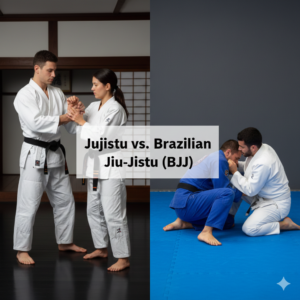
That intense focus on what happens on the ground is what truly sets Brazilian Jiu-Jitsu apart from other famous grappling arts. While they might look similar to an untrained eye, their primary goals are fundamentally different. Judo, for instance, places its greatest emphasis on the throw. The ideal Judo victory is a spectacular one: throwing an opponent cleanly and forcefully onto their back to end the match instantly, often before any prolonged ground fighting occurs.
Wrestling, which many of us recognize from school or the Olympics, has yet another objective. While it features powerful takedowns, the ultimate goal in folkstyle or freestyle wrestling is to pin your opponent’s shoulders to the mat. The fight is a battle for dominant top control, where victory is achieved by holding the other person down in a specific way, proving total physical control.
Brazilian Jiu-Jitsu, in contrast, treats the ground as its primary arena. Where a Judo match might end or a wrestling match might reset, a BJJ practitioner’s work is just beginning. It answers the question, “What now?” with a sophisticated system for achieving control and forcing a submission, regardless of who is on top. This specialized knowledge is what makes the differences between Jiu-Jitsu and Judo so stark, and it’s why BJJ’s ground-fighting system is considered an essential skill in modern self-defense.
Your First BJJ Class: A Step-by-Step Guide to What to Expect
Stepping into a BJJ academy for the first time can feel intimidating, but knowing what’s ahead can turn apprehension into excitement. The process of starting your training is structured and beginner-friendly, and understanding what to expect in your first class demystifies the experience. Most classes follow a consistent and predictable three-part format designed for safe and effective learning.
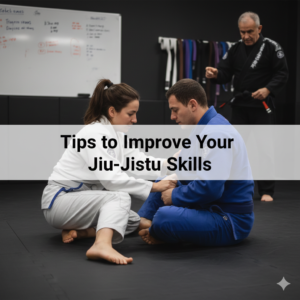
First, you’ll go through a warm-up with movements designed to prepare your body for grappling. Following that, the instructor will demonstrate a specific technique, breaking it down step-by-step. You will then partner up with someone to practice this move in a controlled, cooperative manner called “drilling.” This is where the core learning happens, as you build muscle memory through repetition.
The class typically concludes with a period of controlled, live sparring known as “rolling.” For a beginner, this is not an intense fight. It’s more like a physical puzzle where you try to use the day’s technique against a lightly resisting partner. It is a learning tool, and you can stop at any time by simply “tapping” your hand on your partner or the mat to signal a reset.
Finally, a bit of martial arts gym etiquette for new students goes a long way. These simple courtesies ensure a safe and respectful environment for everyone:
Keep your fingernails and toenails trimmed short to prevent scratches.
Ensure your training clothes (gi or no-gi gear) are clean for every class.
Arrive on time and listen respectfully to your instructors and partners.
Observing these customs shows you’re ready to be a great training partner, whether you’re wearing the traditional uniform or not.
Gi vs. No-Gi: Understanding BJJ’s Two Uniforms
As you begin your journey, you’ll quickly notice that practitioners wear two distinct styles of attire, which define the two major branches of the sport. The traditional jiu jitsu uniform, known as the “gi,” is a thick cotton jacket and pants. More than just clothing, the gi is a tactical tool. Its sturdy collars, sleeves, and pant legs provide a network of grips, turning the match into a deliberate, methodical game of leverage and control. This style emphasizes breaking your opponent’s posture by manipulating the fabric, creating a deeply strategic experience.
In contrast, no-gi grappling is exactly what it sounds like. Practitioners wear modern athletic apparel—typically shorts and a rashguard—leaving no loose fabric to grab. The absence of these grips completely changes the dynamic. The pace quickens, and the style becomes more fluid and athletic, relying on wrestling-style body locks, speed, and positional control. Because you can’t simply hold onto a sleeve, this style forces you to control your opponent’s body directly, making for a faster, more explosive match.
So, for a newcomer, which is better? The best answer is also the simplest: start with whichever style your chosen academy’s fundamental program teaches. Both gi and no-gi will ingrain the same core principles of leverage, position, and submission. The foundational concepts are completely transferable, and the most important step is simply getting on the mat. No matter the uniform, you’re learning the same powerful language of physical problem-solving.

How BJJ Rewires Your Brain and Body: Benefits Beyond Self-Defense
While the principles of leverage and control are at the heart of BJJ for self-defense, most people who train for years will tell you that the art’s biggest rewards show up off the mat. Brazilian Jiu-Jitsu is a transformative pursuit that reshapes not just how you handle a physical confrontation, but how you handle life itself. It’s a holistic system for improving your body, sharpening your mind, and connecting with others.
First, it’s one of the most effective workouts you can find. Forget monotonously lifting weights or running on a treadmill; BJJ is a dynamic, full-body puzzle that engages every muscle. You’ll build functional strength, improve your cardiovascular endurance, and increase your flexibility without ever feeling like you’re just “exercising.” Because your mind is so focused on solving the problem in front of you, the incredible fitness and weight loss benefits feel like a welcome side effect of having fun.
Beyond the physical, BJJ is often described as “human chess” for good reason. It forces you to stay calm and think strategically while under intense physical pressure. When you’re in a difficult position, panicking is the worst thing you can do. Instead, you learn to breathe, assess the situation, and methodically work your way to a better spot. This ability to find clarity in chaos is a superpower that translates directly to high-stress situations at work and in your personal life.
Perhaps one of the most unexpected benefits of Jiu-Jitsu is the community. In a BJJ academy, you’ll find people from all walks of life united by a shared desire to learn and improve. It’s an environment built on mutual respect and support, where your training partners are invested in your growth. You aren’t just joining a gym; you are becoming part of a team.
Ready to Roll? Your 3-Step Guide to Starting Your BJJ Journey
Having explored its core principles, the world of Brazilian Jiu-Jitsu may no longer seem like a mysterious, complex landscape reserved only for elite athletes. You can see past the scramble and recognize the “human chess” match unfolding—a game won with leverage and intelligence, not brute force. More importantly, you have a clear map for turning curiosity into a confident first step.
Your first mission isn’t to master an armbar, but simply to find a local school and observe. When you take that trial class, remember that you aren’t being tested; you are interviewing the gym. Ask yourself: How does the instructor treat the newest people in the room? Do the other students seem welcoming and patient? Choosing a jiu-jitsu gym is less about the trophies on the wall and more about finding a clean, safe environment where you feel you can grow.
Ultimately, BJJ is far more than a self-defense system. It’s a path to physical fitness, mental clarity, and a surprisingly strong sense of community. The journey doesn’t begin with learning how to fight, but with the simple decision to walk through the door. The mat is waiting. This website is dedicated to publishing in-depth Brazilian Jiu Jitsu bjj educational content.